Field-tested insight on inspection techniques.
Practical articles on inspection methods, asset integrity strategy, and the technical decisions behind reliable NDE data — written by the AIT team.
A free browser tool for piping drawings.
NDE Draw
A free browser-based markup tool where inspectors drop CML bubbles and leader lines onto PDF piping drawings, add redline annotations, and navigate multi-page PDFs. Export a clean, flattened professional PDF — the original drawing is never altered. No install needed.
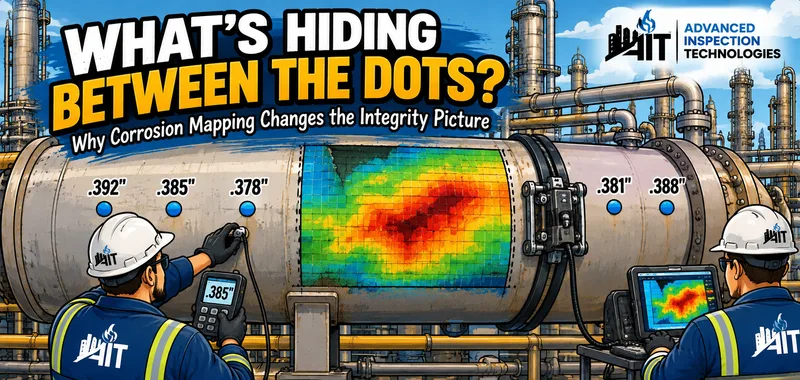
What's Hiding Between the Dots? Why Corrosion Mapping Changes the Integrity Picture
Spot UT reads the CML dots. Encoded AUT corrosion mapping shows what's hiding between them: 100 readings per square inch at 100% coverage, and the minima, morphology and documented coverage integrity teams need for API 510, 570 and 653 decisions.

When One Collar Sees Nearly 500 Feet of Pipe
One bi-directional Guided Wave UT collar screened roughly 473 linear feet of coated 8-inch process piping in a rack — what that long shot really shows, where elbows win, and how AIT turns GWT into integrity decisions.
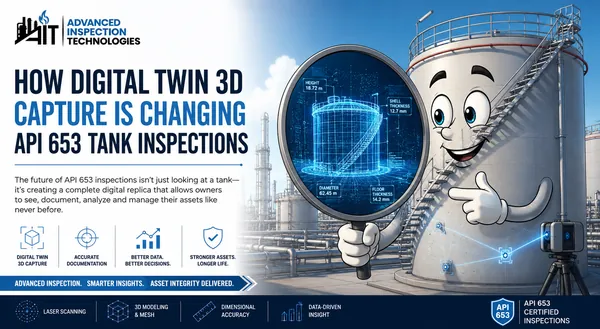
From Clipboards to Coordinates: How Digital Twin 3D Capture Is Changing API 653 Tank Inspections
Why capturing the tank interior in 3D at inspection and after repair turns the inspector's painted patch boundaries into a permanent, navigable record — and gives owners, FFS engineers, and MI managers verification that the contractor placed the patches where the API 653 inspector called for them.

Which Way Do You Go? API 583 & CUI Inspection With 19 Different NDE Methods
API RP 583 lists 19 NDE methods for Corrosion Under Insulation. A field-tested breakdown of what each one does, where it fits, and how to combine screening, confirmation, and sizing into a CUI program that actually finds damage.

When the Report Beats the Truck to the Gate: Fast Tubing Inspection That Keeps the Bundle Decision on Schedule
Why method selection (ECT, RFT, NFT, IRIS) and analysis-alongside-acquisition reporting determine whether tubing data lands in time to drive the bundle decision.

When the X-Ray Truck Has to Go: Why More Operators Are Replacing Radiography with Phased Array UT
How encoded PAUT (and TOFD) is displacing radiography for volumetric weld inspection — safety footprint, schedule throughput, code acceptance, and where field judgment still matters.
Ready to scope your next inspection?
Tell us about your facility, scope, and schedule. An AIT inspection specialist will follow up to discuss methods, mobilization, and reporting.