
A 150,000-barrel crude tank comes out of service for its scheduled internal inspection. The MFE floor scanner makes its passes. The UT crew proves up every cluster the scanner flags. The API 653 inspector walks the floor, evaluates the data, and gets to work with a can of spray paint — sizing each patch repair to clear weld spacing requirements, marking the full boundary of every area that needs to come out, and numbering each floor plate so the report and the field match up.
By the time the inspection team walks out of that tank, the floor is a map. Numbered plates. Painted boundaries. A record of what the inspector found, evaluated, and recommended — drawn directly on the asset.
Then the tank gets handed to the repair contractor. And somewhere between that painted floor and the finished repair report, the question that will follow this asset for the next decade takes shape: how do we know the patches went where they were supposed to go?
What the Inspection Team Sees — And What Everyone Else Doesn't
The inspector who walked that floor has a complete picture. They've seen every shell course, every nozzle, every floor plate, every stairway and obstacle. They know which plate is numbered 14, where the sump sits relative to the corroded zone on plate 22, how the spray-painted patch boundary on plate 8 was sized to clear the adjacent weld seam. That spatial understanding lives in their head — and in their report, translated into numbers, photographs, and narrative.
Everyone else on the project — the owner's mechanical integrity engineer, the FFS engineer reviewing fitness for continued service, the plant manager approving return to service — works from those translations. They read the report. They look at the photos. They try to build a mental picture of a confined space they've never entered, from documentation that was never designed to give them one.
For most of the history of tank inspection, that was simply the constraint. You either went inside, or you worked from the report.
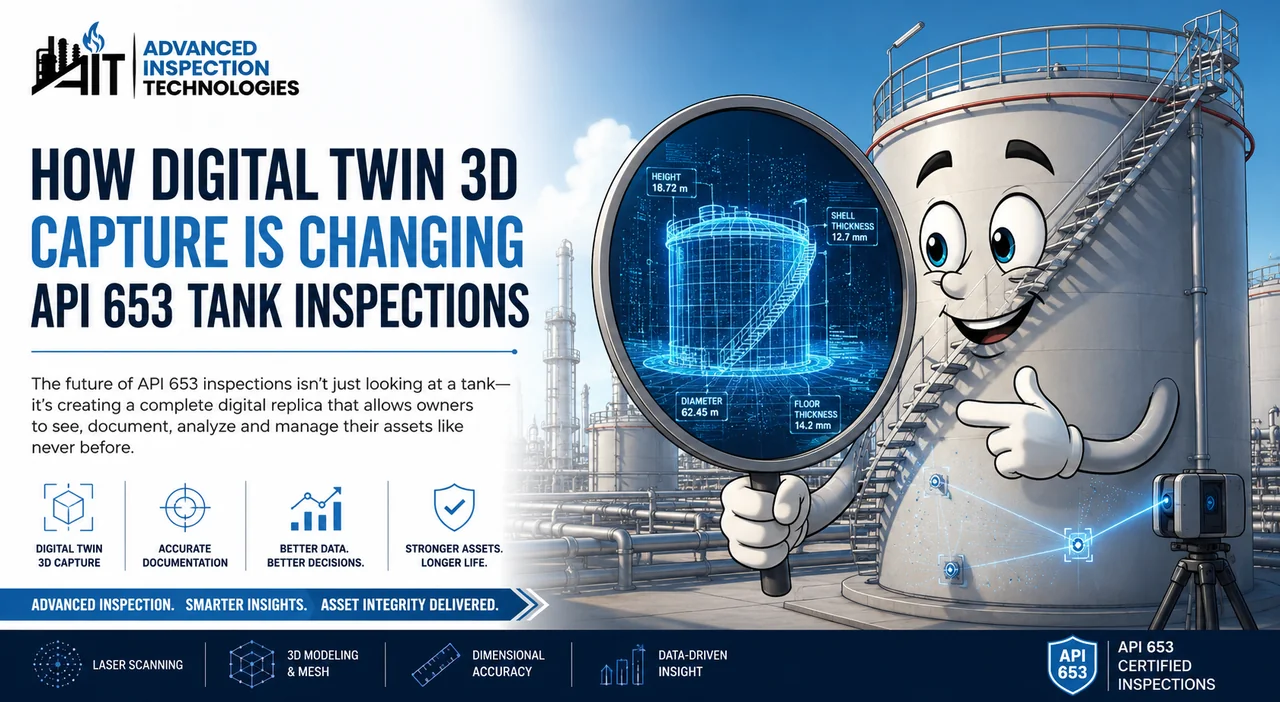
Digital twin 3D capture changes that constraint entirely.
The Owner Walks the Tank From a Desk
When 3D capture is performed during the inspection window — after the MFE passes, after UT proves up the indications, after the API 653 inspector has walked the floor and spray-painted the repair boundaries — the result is a navigable model of the tank in its as-inspected condition.
Every floor plate, numbered as sprayed. Every shell course. Every nozzle, ladder, stairway, and floor obstacle. The spray-painted patch boundaries the inspector drew, visible on the plates where they were drawn. The full interior of the tank, spatially accurate, accessible from any computer without a confined space entry.
The owner's engineer can open that model and walk the tank. They can navigate to plate 22, see the corrosion zone the UT crew proved up, and see the patch boundary the API 653 inspector sized around it. They can look at the proximity to the sump. They can check the relationship between the marked repair area and the adjacent weld seam the inspector was working around. They can do all of this without a site visit, without a phone call to the inspector, and without trying to reconstruct spatial reality from a PDF.
That's not a convenience feature. For an owner managing a fleet of tanks across multiple terminals, or an engineering firm supporting a program remotely, virtual access to the as-inspected interior is a fundamentally different capability than a report with photographs. The inspection team's complete field picture — everything they saw, documented in the space where they saw it — becomes accessible to everyone who needs it.
The Spray-Paint Boundary Is Now a Permanent Record
The patch boundaries the API 653 inspector draws aren't arbitrary. The MFE identified a cluster. UT proved it up — confirmed wall loss, mapped the extent. The inspector evaluated the data, determined what needed to come out, and drew the repair boundary in paint: large enough to cover the full evaluated zone, sized and positioned to meet weld spacing requirements, documented on a numbered plate so the repair report can reference it precisely.
That painted boundary represents real engineering judgment. It's the inspector's professional determination of exactly what the repair contractor needs to do.
Before 3D capture, that judgment lived on the floor until the contractor's grinders arrived. After that, it was gone. The repair report would document what was installed. Whether the installed patch matched the boundary the inspector drew — whether it covered the full evaluated zone, whether it was positioned correctly relative to the plate number and the surrounding welds — was a matter of trusting the contractor's sign-off and the inspector's final walkthrough.
After 3D capture, that spray-painted boundary is in the model. Permanent. Spatially referenced to the numbered plate it was drawn on. Accessible to any reviewer before, during, or after the repair work.
Post-Repair Overlay: Verification That Sticks
When the repair work is complete, the floor gets scanned again. The post-repair model is overlaid against the pre-repair scan.
The question the overlay answers is straightforward: did the contractor place the patches where the inspector said to put them?
On a numbered plate where the inspector drew a boundary, the overlay shows whether the installed patch covers that boundary — the full evaluated zone, the spray-painted perimeter the inspector sized to meet weld spacing and overlap the entire area of concern. If the patch matches, that's documented. If the patch falls short of the marked boundary in any direction, that's visible in the overlay before the tank goes back into service.
This matters because patch placement errors are not hypothetical. A repair contractor working from a report and a numbered plate reference, under schedule pressure, in a tank with partial lighting and uneven floor conditions, can place a patch that's close but not right. "Close" on a floor repair isn't acceptable when the inspector's boundary was drawn to capture the full extent of a corrosion zone that UT confirmed.
The overlay doesn't replace the inspector's final sign-off. It gives that sign-off something to stand on.
Engineering Support and the Remote Review Problem
API 653 projects routinely involve stakeholders who never visit the tank. The Fitness-for-Service engineer running calculations against API 579. The mechanical integrity manager coordinating repairs across a terminal. The owner's technical authority approving return to service.
In a conventional documentation workflow, remote review means working from a report — photos, thickness tables, narrative descriptions, the plate-referenced coordinate table. Questions about spatial context require a call to the inspector, who may be three tanks and two facilities removed from the one being discussed.
With a 3D model as the project record, remote review means navigating the tank. The FFS engineer can go directly to the floor plate their calculation depends on. The MI manager can check whether the repair boundary on plate 14 was fully covered before approving contractor sign-off. Questions that used to require a site visit or a lengthy phone exchange get answered in the model in minutes.
The Cost Conversation Is a Short One
By the time a tank owner reaches the point where a 3D scan would be captured, they've already committed to one of the most expensive maintenance events in their asset program.
Taking a large storage tank out of service isn't a casual decision. Product has to be transferred out. The tank has to be cleaned — a significant cost on its own, involving sludge removal, vapor freeing, and gas monitoring before anyone enters. A confined space program has to be stood up and maintained for the duration. The inspection scope — MFE, UT, shell thickness, roof, nozzles, API 653 evaluation — runs its course. Then the repair contractor comes in. Then the repairs are inspected and documented. Then the tank is buttoned up, tested, and returned to service.
That full sequence — outage, cleaning, confined space program, inspection, repair, return to service — represents an investment that, depending on tank size and repair scope, can run well into six figures before the owner opens the inlet valve again.
Against that backdrop, the cost of adding a 3D digital twin capture to the scope is, in practical terms, negligible. The scanning happens during the inspection window that's already open. The confined space entry that's already permitted. The crew that's already on-site. What the owner gets in return — a permanent, navigable, spatially referenced record of the tank's as-inspected condition and its post-repair state — protects every dollar that went into that outage.
If a question arises during the next inspection cycle about where a previous repair was placed, the answer is in the model. If a regulatory body asks for documentation of the repair scope and the contractor's execution of it, the overlay is the answer. If the owner's engineering firm turns over and a new team inherits the integrity program, the 3D record gives them a complete picture of every tank in the fleet without a site visit.
The ROI on 3D capture isn't complicated. The outage already cost what it cost. The scan is the cheapest insurance policy on that investment — and it pays out every time someone needs to understand what happened inside that tank.
A Historical Record That Holds Up
Ten years from now, when this tank comes due for its next internal inspection, the incoming API 653 inspector will want to know what the last inspection found, where the repairs were made, and what the floor looked like when it went back into service.
The pre-repair 3D scan shows the as-found condition — numbered plates, UT-confirmed zones, spray-painted repair boundaries. The post-repair scan shows what was installed and where. The overlay confirms the patches matched the scope the previous inspector called.
That documentation chain is what API 653 record-keeping is supposed to produce. The 3D model doesn't replace the inspection report, the thickness data, or the corrosion rate calculations. It gives all of that data a spatial home — one that the next inspector, the next engineer, and the next owner can navigate without having to trust that the paper records match what actually happened on the floor.
The Takeaway
Tank inspection has always generated good data. The MFE finds it. UT proves it up. The API 653 inspector evaluates it and marks it. The gap has always been in translating that field judgment into documentation that everyone who needs it can actually use — without going inside the tank themselves.
Digital twin 3D capture closes that gap. The owner sees what the inspection team saw. The engineer reviews what the inspector marked. The overlay confirms what the contractor built. The record survives for the next inspection cycle, spatially intact.
The cost to add it to the scope is a rounding error on what the outage already cost. The documentation it produces is the one asset that outlasts the outage, the repair crew, and every personnel change between now and the next time someone needs to understand what happened inside that tank.
If your API 653 program isn't capturing the interior at inspection and at repair completion, you're leaving the most important part of the documentation outside the report.